


This little work-in-progress comes from a big work-in-progress. Some sections are new, most of it is pulled from one or two sentences from my book or from forgotten fits and starts that live in an unwieldy folder called frags. I’ve been soft-puzzling some pieces together. Lately I can only manage to write forward if I imagine placing words in small squares and rectangles, or, like, building a miniature five-story brownstone fever dream out of cardboard and found objects. You’re invited. Come on in. Watch your head.
ALSO: Works-in-progress shared here will likely be paywalled going forward. Don’t sleep on the house parties. Join the fold.
xo Blaise
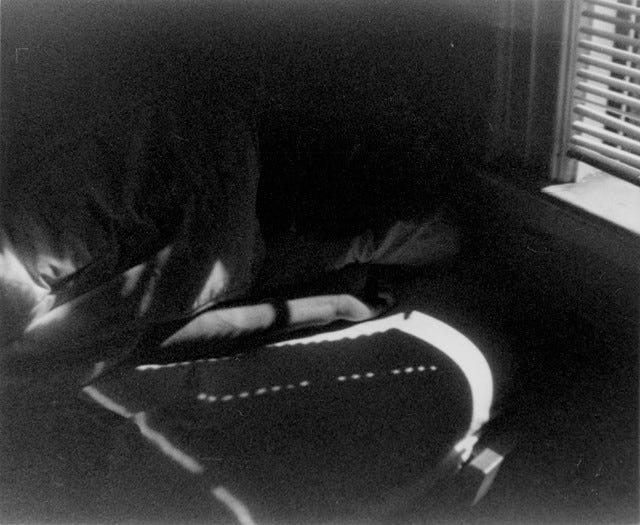
I. Silent Generation
As soon as dad walked out the door, I grabbed my green Bic lighter and my Camel Lights hard pack. He’d left that morning on an overnight trip, and the thing about it was that I’d been living with him full-time for three years by then and he’d never gone away for more than one day. Even when he’d drive four hours to visit my Nana, he’d come back the same night. I was pretty sure it was at least in part because he was afraid of what I’d get up to alone for a whole weekend, but I was raised on cable and movies of the week so I knew throwing a party would do irreparable damage. Smoking in the house would be my only delinquent act that Saturday. In the house, at least.
I sat in one of the Mexican chairs at the round Mexican table. They were traditional, handmade from natural cedar wood and leather. (They’re called equipale, but I didn’t know that then.) Dad brought them back from Mexico. We’d been there a few times when I was almost too young to remember, but I remember some things. The chairs are cool and homey but so not the most comfortable. I once asked my dad, who had lifelong back problems, why we didn’t have a couch. He said, “because I’ll just sit on it and watch TV all the time.” So he watched TV all the time in the back-breaking Mexican chairs instead. I didn’t see how getting a couch would make much of a difference.
The house was quiet, clean, and airy for a house that had a lot of shit in it — clutter but in the form of ceramics and wood sculptures and framed art and plants and books and art magazines and glassware, newspapers, and family antiques. The sun pressed through the open windows, an early breeze whispering through the sliding screen door from the back porch. I fiddled pensively with the heavy glass ashtray, turning it one way, then the other, and took two deep, slow drags from my first cigarette of the day. This was freedom. I needed coffee to go with it.
I pushed out my chair and placed the lit cigarette in the divot of the ashtray. I stepped into the kitchen less than 100 feet away to make Maxwell House instant from packets I’d lifted from my two-day-a-week summer job. Dad didn’t drink coffee and didn’t think I needed to either. When the coffee was ready, I added milk and sugar, tasted it, added more milk and sugar, stirred it, tasted it again, and tossed the spoon into the sink.
I miscalculated how much time I was taking in the kitchen. When I went back to my spot at the table my smoke had smoked itself, all the way down to the filter which now lay on an ant hill of its own ash and dust and the only sign of its former life was a black hole burned into the leather table. I stood there with my mouth open, staring at the hole that was the size of two thumbnails, and thought and thought about what to do, though I refused to think too much about how there could have been an actual fire. Fuck. I’d also wasted a Camel Light; I only had two drags. There was just no way to fix it, at least not that I could think of, no way to cover it up so dad wouldn’t know. There was nothing I could do, so that’s what I did.
There was an outline of the burn hole; like, whatever the story was behind it was traced on the surface with a fine-tip Sharpie. You couldn’t make it disappear.
Dad said nothing the next day. Not even the day after that. I knew when he was sitting at the table, maybe reading the paper or opening the mail, because from my bedroom I could hear the creak and crunch of the stretchy pigskin from my bedroom. It sounded almost like a bean bag chair giving way and adjusting to the weight of a person. Of course I could hear the TV that stood in the corner on a wood console dad made. It was always at least five decibels too loud. Days went by, I fretted and cringed frequently. We’d even sit at the table next to each other sometimes, together but not really together, eat dinner or whatever, not talking, or maybe talking a little, trading sentences back and forth. Every time I was in that room I’d casually put my plate or whatever I had with me right over the hole. I didn’t want to remind him it was there. Mostly, I didn’t want to see it.
Then one day, a patch over the hole appeared. I knew dad had found some leather from a stockpile of random pieces in his art studio at the back of the house. He’d cut it to the exact size of the hole and glued it down with something. The color matched perfectly. He must have saved some leather from one of the old Mexican chairs that had finally torn at the seams. But the hole wasn’t a perfect circle to begin with. The edges dad carved were clean, but the patch had to fit inside the hole, not over it, in order to keep the surface smooth. There was an outline of the burn hole; like, whatever the story was behind it was traced on the surface with a fine-tip Sharpie. You couldn’t make it disappear. Anyone who looked at the surface could clearly see that something had happened there, but no one except my dad and I were the only ones who could say how or why.
II. Please Go Away
My mom bought a stucco house on a dead end road. I was 12, and it was our fourth move, not including two temporary stays at other people’s houses. I hated this stucco house. It was ugly and I was sick of moving.
Down the road from the house, on the corner of a suburban thoroughfare, was a travel agency with a marquee that read “Please go away.” We drove by it almost every day. It bothered me every time I looked at it through the car window, and I always looked at it. I thought the sign meant they’d gone out of business, but one day I noticed that the office was open and the marquee still said “Please go away.” So then I thought maybe the sign went up every day at 5:00pm, but that didn’t seem right. I couldn’t make sense of it. Finally, I said something to my mom. I told her the sign was rude, and I told her they couldn’t expect to do business at a travel agency if people think they’re being told not to even go into the travel agency to do business in the first place. Then my mother explained it to me. I said the joke wasn’t very funny. After that, whenever we’d drive by, I’d look at the travel agency’s “Please go away” sign with an evil eye. It still gave me a real bad feeling.
III. Ways To Get Around
My half-brother and I happened to be standing in dad’s kitchen at the same time, looking for something to eat. Whenever he’d visit dad, I never knew how it was going to go. Even from the moment he’d walk in the door, there was just no telling whether or not he would even speak to me.
But one thing I knew about my half-brother: he loved doling out unsolicited advice and telling everybody what they should do — like, about anything. I was a college sophomore about to move to New York for a three-month field work stint and he’d lived in New York ever since he graduated college. So he started giving me instructions on how to get around New York.
“You gotta know the rules,” he said. “Never look up at the buildings. Someone will think you’re a tourist and they’ll mug you.”
He chuckled to himself.
“And if you’re not sure where you’re going,” he went on, “or you realize you’re going the wrong way, don’t turn around and don’t stop to ask anyone for directions. Because if they know you’re lost, they’ll think you’re a tourist. And they’ll mug you.”
He laughed again, but he was dead serious.
“What you do is, you walk around the block. You turn the corner, then another corner, then another corner, until you’re going the right way.”
I’d road tripped to the city with friends more than enough times to know that walking around the block meant you could forget about getting anywhere on time. One New York block is a long-ass walk. My second issue with his rulebook was that I have no sense of direction and I can’t do math. You cannot teach me north-south-east-west, or how to understand numbers. Far, far too many have tried.
I was never his favorite person.
I told him all this. I knew what I was talking about. Like, if you drew a map of my route it would look like a platter of linguine.
“Nah,” he said, “You’ll do fine. Don’t talk to anybody and don’t look anybody in the eye. It’s simple!”
He was pleased with himself for mixing comedy with instruction.
He’d been at the house for two days and this was the first time he spoke to me. When he was a kid dad abandoned him and his mother for my mother, and dad moved three states away so he only saw dad occasionally. Also, they were a black family, and my mother is white. ALSO, when dad said to him, “you have a sister,” I was already three, and he was in middle school. I was never his favorite person.
“I’m not following those rules,” I said.
“Look, just walk like you mean business. Always look like you know where you’re going, no matter where you end up,” he told me. “It’s the only way to get around unscathed. I’m telling you.”
IV. Return Trip
June 21st, 2023
I’m coming home from a weekend with Dad. I’m on Amtrak and we are almost back in New York, ten minutes to go. Dad’s birthday is around the corner, on August 30th, and that’s when I plan to go back.
Lately I’ve been experiencing what they call anticipatory grief. My dad uses a walker now. He only sees out of one eye, and poorly at that. Botched glaucoma surgery. He squints with the other eye, though you can’t really tell until he opens it. Then he sees shadows and black spots. He says it feels like there’s a pebble in his eye. He also can’t hear well, even with his hearing aids, which I think is not just about the quality of the device.
When I read this to myself once I’m home, I will pause and think, wasn’t it somebody’s son? Now I’m not sure.
A white woman in the window seat across the aisle from me gets a call. Within seconds she’s almost howling. “No,” she sobs. “I’m so sorry,” she says. The conversation is fairly brief.
When she gets off the phone she is inconsolable. Her partner in the aisle seat directly across from me keeps his hand on her leg, calmly leaning into her. The train car is otherwise quiet. It’s impossible not to hear. It sounds like the person who died was somebody’s daughter — is somebody’s daughter — though when I read this to myself once I’m home, I will pause and think, wasn’t it somebody’s son? Now I’m not sure. My dad will die the following year, but I don’t know that yet, but in a way I do.
Then I hear the woman say to her partner, “I was so scared it was my dad.”
I remember I have a clean napkin in my bag from breakfast and I want to give it to her. I hold by the corner and reach across the aisle. She doesn’t notice. Her head is down and she’s wiping her face with her hands. I hand it to the guy. He puts his hand lightly on my arm and says thank you very much. He smiles at me. Then he places the napkin in the woman’s hand. She doesn’t look up, just takes the napkin and presses it against her face. I want to turn around and go back to the place I just came from.

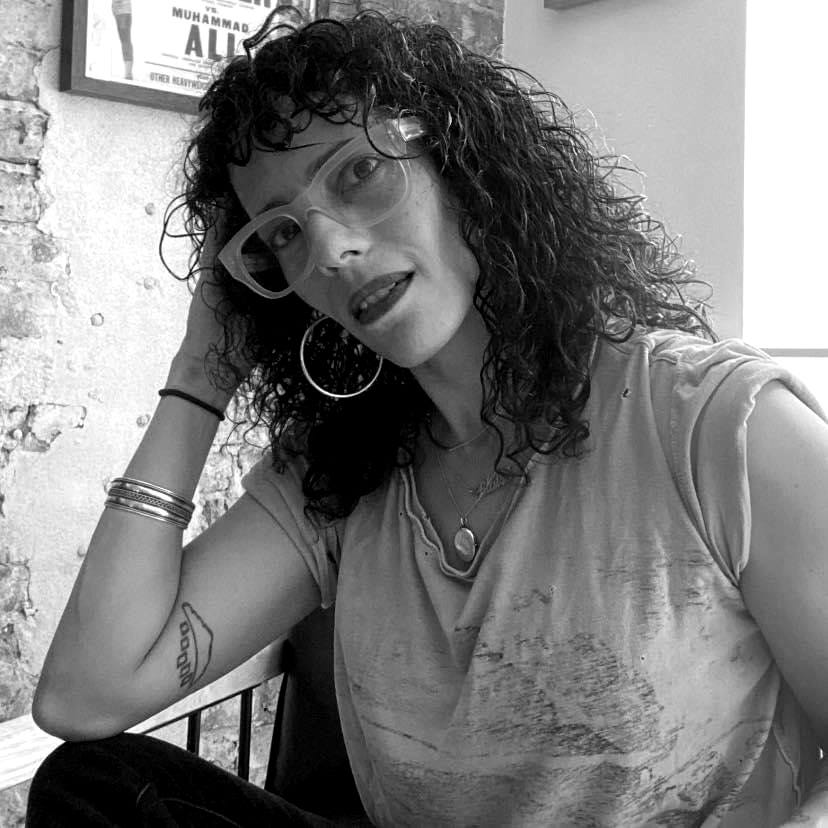
Blaise Allysen Kearsley is a black biracial Brooklyn-based writer, teacher, coach, and the founder of the HOW I LEARNED live show and online magazine. To learn how to pronounce all of her names, visit blaiseallysenkearsley.com.
These go together perfectly somehow. I'm going to think about the little leather patched up hole in that table for a long time. You write so beautifully.
hi Blaise. just to say I love your writing it. - th pacing and the specificity of everything. I always feel I'm right there w/ you. can't wait to read more. and yes to the bits and frags - good to know that that's just who we are. I think it's just a waste but when I discover you store the same I feel better. happy end of summer OX