


Summer trickled slowly at first, and then all at once, through the flimsy film of Spring, growing harsher with years as climate change took its toll and changed the landscape of north India — floods, landslides, tourism in the hills disrupted by the fear for life.
I was working to form an identity that year, but I was stuck experimenting between my privilege to leave — still living with my parents, not obligated to contribute to any expenses — and my disadvantage of being unable to afford to move to a different city, somewhere with a job I could be passionate about. From one job to the next, misery, the dull ache of a life being wasted, a flaring wound on my open heart. At only 21 years old.
Red brick houses, quarters built for migrant labourers, their kids playing in the street, on the terrace. Stories of workers losing their hands to factory machinery, or their lives to heatstrokes, so that a businessman can host his son’s wedding abroad.
I felt nostalgia or something worse, resentment for the year I had spent being only a human. Oh, the great suffering of one’s early 20s, I thought. I had perspective. This was normal. I was on a journey. I was just moving slower than everybody else.
***
One day, on Ferozepur Road, at the turn near the Bharat Nagar Chowk, a man slept, flies all over his head. I passed him on my way to university. Sleeping. Dead — it crossed my mind. The city running around him, as busy as ever. Students to colleges, people to offices, and a man dead, I thought. We have killed him. And we dare not look at what we have done.
***
The Grand Trunk Road ran parallel to the street we lived on, surrounded by industries. Clothes being woven, cycle saddles being stitched, nuts and bolts taking shape, the grrrrr of the generator filling the house every time we had a power outage. Red brick houses, quarters built for migrant labourers, their kids playing in the street, on the terrace. Stories of workers losing their hands to factory machinery, or their lives to heatstrokes, so that a businessman can host his son’s wedding abroad, fly all his friends out, throw a 5-day event. Dignity of one to feed the ego of another. A faded blue shirt, black with dirt, for a crisp blue shirt ironed to perfection, with a coat on top.
I was working at a factory like this. It was the third job I was trying out. I worked in the adjoining corporate office, a concrete modern building, conference rooms and glass doors right next to a bloody affair. When I joined, they gave me a tour, and all I could remember were tens of lifeless eyes, earphones plugged in, mechanical motions.
I would leave for home at 6:00 in the evening in an auto rickshaw, amidst people scrambling home and stares of men who I would try to empathize with, my fellow passengers. Oh, how tired they were, I thought. How could I think of them as ‘bad’ merely for staring at my chest? They were feeding their families, losing themselves in the process so the country’s GDP could grow. The country had earned its status as the 4th largest economy at the cost of their blood and sweat, after all.
Big commercial vehicles, trucks carrying hosiery in and out of the city, swarms of cars and cars, and my auto-rickshaw, which would stay beneath the flyover so it could pick up more passengers. That killed me too. Sweaty men closing in on me. Two months in, and I was ready to leave.
The final stretch of GT Road, just before home, had a slum on its bank. The road was a river, in a way. Vehicles like fishes swimming upstream-downstream. I saw it everyday: a torn pink sofa left on the side of the Grand Trunk Road. But that day: a naked child — what, two years old? — sitting on the sofa, dirtied with mud. To the side, a woman at a clay stove, cooking what I imagined was their only meal of the day, carving out their suffering in concrete terms. The sofa was always there, but it stuck only this once, and then it never went away.
I felt nostalgia or something worse, resentment for the year I had spent being only a human. Oh, the great suffering of one’s early 20s, I thought. I had perspective. This was normal. I was on a journey. I was just moving slower than everybody else.
***
My mother changed her name after she married my father. She lived two very distinct lives. One as Sudesh, or better still, Manti. The other as someone who only exists on government IDs and forms. She is mother. Just that. Primarily that.
She was raised by a village and then became the only one raising three kids. Her busyness leaked into my life in the form of neglect, which rooted itself as a sadness in my chest – the awareness of a hole and the knowledge of what could fill it.
My mother said life was a gift because it simply could have not been, and I never would have known. It was a pleasant present. Not something I needed, but something I still got. My life, a gift I had used to kill people, take away their childhoods and their hands.
I have done nothing and still killed the man. I have been a part of the system. Suffered from it, benefitted from it. A child studying abroad. At what cost? A child naked on a roadside sofa.
The GT Road child was distinct, he would not know that he was suffering – that young boy. He did not know, not yet, what suffering was. That hands were lost to factory machines and that a woman cried on the bathroom floor and sometimes on public transport because she hated her life. And that one could kill oneself or at least find comfort in the availability of that option, that we were all murderers. Not he, of course. Never him, I hoped.

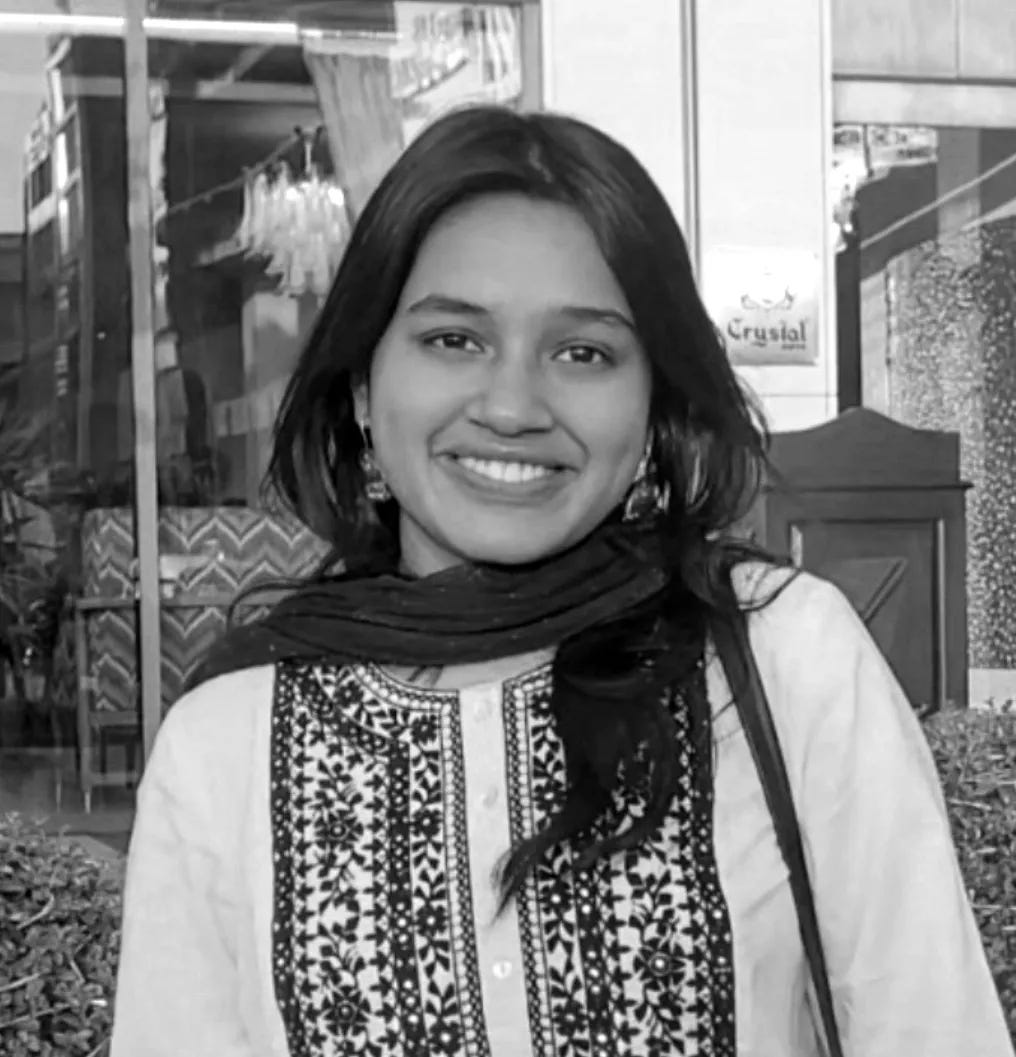
Riya Jindal is a 22 year-old graduate in Economics and Philosophy and is currently working as a Production Assistant at a local radio channel. She is curious, loves to read and plays the guitar.
Incredible how the sofa becomes this anchor point for understanding complicity. The way privilege creates this paralysis wher e awareness doesn't necessarily lead to action is spot on. I spent time in Delhi and saw similar scenes, and still grapple with how economic mobility for some requires stagnation for others. The naked child image cuts throuhg all the abstractions about inequality.
One feels the pulse and the tragedy of life here. The sofa scene really does anchor the story - what a scene- a glimpse into what I imagine is a chaotic world of heartbeats, breaths, and survival.