


If you’re alive long enough, memories become like a burlap bag of rocks you lug around, with some hunks of silver and gold occasionally glinting through the rubble. Over time, as the bag increases in weight, the fibers fray and give way and some rocks fall out, along with the occasional chunk of precious metal.
Case in point: My memory sucks so badly that I recently PM’ed a close friend from junior high, desperate for details about spending my 13th birthday at The Go-Go’s and A Flock Of Seagulls concert at the Boston Garden to write what could’ve been a moving essay about my budding adolescence, only for her to politely reply that she wasn’t invited.
The Go-Go’s were something of an anomaly at the time — an all-female band — and despite the frothy femme image they were reluctantly shoved into by the media, they had preserved a rebellious edge and a firm resistance to patriarchal mores, ways, and means that resonated deeply with my misfit teenage spirit.
What Belinda Carlisle or Charlotte Caffey wore onstage that night, the particulars of the setlist, or how the band sounded, are details that have long tumbled out of my burlap sack. I also don’t remember what I could’ve possibly said to my parents to convince them to buy me and a few of my friends tickets to this show. I clearly don’t recall who went with me, or what happened when we got there, but what did make an indelible impression on me is the rapturous joy I felt when watching the music I love so much performed live, because it’s a joy I pursue as often as humanly possible to this day.
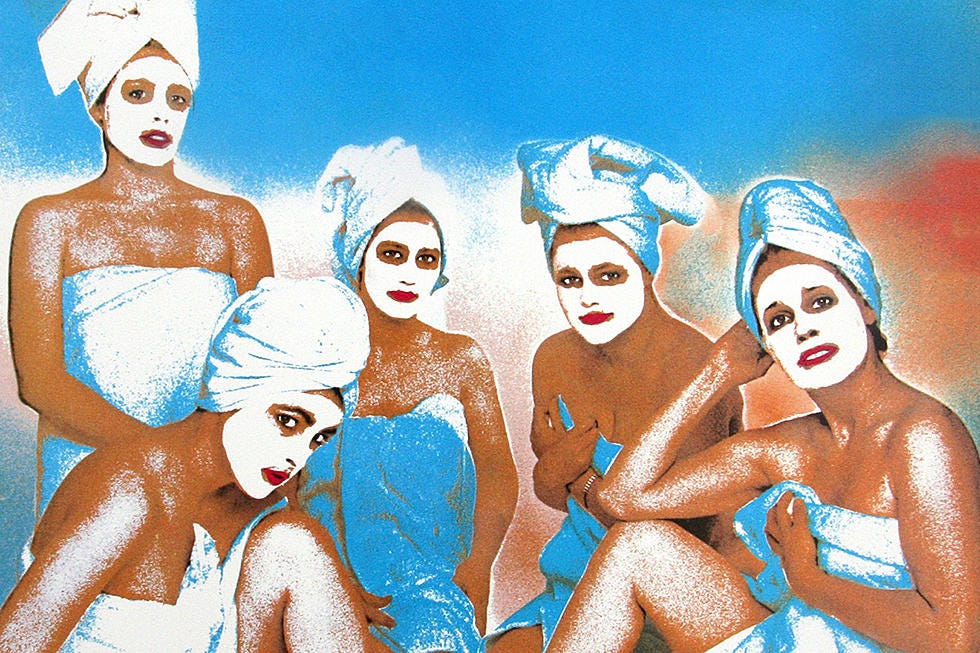
When The Go-Go’s first got national attention in the very early ‘80s, they made jangly pop music that appealed to teen girls and young women without sanded edges and a lacquered sheen. Natives of the L.A. late ‘70s punk scene, their first album, Beauty and The Beat, was chock full of catchy, scratchy tunes about self-preservation, lust, longing, and a no-tolerance policy for bullshit held together with jangly guitars and, of course, the beat.
To wit: The single “We Got The Beat” was a poppy anthem about the joy of music, but the album’s other major hit, “Our Lips Are Sealed,” was about a clandestine hook-up between guitarist Jane Wiedlin and Terry Hall, Brit singer of the Fun Boy Three and The Specials. A listen to the lyrics could lead one to speculate that one darker track, “This Town,” was about the underbelly of the Los Angeles punk scene; “Lust to Love” was about being dickmatized; and “Automatic,” the darkest, most hypnotic song on the record, is about mechanical, loveless sex. Vacation, subsequent to Beauty and The Beat, would be a markedly glossier effort, all punk predilections and day-glo aggression made smooth and palatable for mass and major label consumption. But, as poppy as it could be, Beauty and The Beat preserved elements of the darker, feminist edge of their grittier punk roots.
The Go-Go’s were something of an anomaly at the time — an all-female band — and despite the frothy femme image they were reluctantly shoved into by the media, they had preserved a rebellious edge and a firm resistance to patriarchal mores, ways, and means that resonated deeply with my misfit teenage spirit. That night, they showed me that women could (literally) band together and make art without giving a shit what guys thought. Being in that crowd that night felt more like being in a movement than just taking in a concert.
Meanwhile, their openers, A Flock Of Seagulls, were a British band that looked and sounded like the future. With his awesome blond skyward coif, singer Mike Score made rhythmic pop set to shimmering synths that inspired thoughts of what our lives might look and sound like as we moved toward an existence akin to an episode of The Jetsons. It felt passionate and deliberate, yet rife with possibility. This made clear that, though Led Zeppelin and other Boomer relics were intent on dominating radio, the path forward for me would be as femme-y and futuristic as a Thierry Mugler bustier.
The Go-Go’s and their scrappy punk rock spirit would trickle down to my 8-year-old daughter. She was dedicated to learning the drums — a pursuit I was quick to endorse despite the confines of our minuscule Brooklyn apartment.
To the male music critic in attendance that fateful night, The Go-Go’s were relegated to the inside of a pink, transparent, Bubble Yum bubble. “Whoever thought the ragamuffin Go-Go’s, who started on a wing and a prayer four years ago, would become such trendsetters?” wrote Steve Morse, the Boston Globe music critic, in a review of the show I attended (again, thank you, Internet). After describing the show as a meeting place for “flocks of teenaged girls” who were “fashion conscious” but “too young to go to a disco” and intent on invoking “bedlam pure and simple” (well, true), their music and performance were relegated to deeper paragraphs. He did accurately compare aspects of their sound to an ‘80s version of The Beach Boys in terms of planting fantasies in their listeners’ minds, but that’s all the kudos they would get. “It’s light and fluffy stuff,” he wrote, reductively, “but thoroughly entertaining.” If someone wrote that about Taylor Swift today, a large army of Swifties would assemble and doxx them within an inch of their life.
Maybe Morse didn’t get The Go-Go’s because they had no intention of placating the male gaze, and this was right up my alley. At 13, I already knew deep down that I wanted to live my life that way. When you’re 10, 11, or 12, turning 13 feels like an initiation, a first foray into the soft shadows of who you’d grow into. It was of the utmost importance to me to stray as far as I could from the objectified, indentured version of womanhood I saw all around me, at home and in the media. The womanhood I wanted to experience was closer to what The Go-Go’s represented. By sheer virtue of being an all-female band, The Go-Go’s (along with predecessors Chrissie Hynde from The Pretenders and Joan Jett) gave me evidence that it was possible to make the kind of art I wanted, in the company of supportive women, without having to drape myself seductively in a bikini across a GTO to sell it. After seeing that tour, countless budding teens, such as myself, were inspired to put down the hairbrushes they sang into and instead pick up a mic or an instrument. Even if just for myself, I’ve made music, written music, written about music, and been inspired by music ever since.
“Hey Ma!” she called out — all of 8 years old back then. “Did you know that Gina Schock moved to L.A. in a pickup truck with $2000 and a bag of cocaine?” How did she know how to pronounce ‘cocaine’?!
Decades later, as fate would have it, The Go-Go’s and their scrappy punk rock spirit would trickle down to my 8-year-old daughter. She was dedicated to learning the drums — a pursuit I was quick to endorse despite the confines of our minuscule Brooklyn apartment. In my daily travels, I stumbled across a copy of Tom Tom magazine, a now-defunct (in print) publication that celebrated the female drummer, featuring an interview with Gina Schock from The Go-Go’s. How could I not bring that home for my daughter to check out? With only a cursory glance at its contents, I handed it to her and she ran off to her room to crack it open.
“Hey Ma!” she called out — all of 8 years old back then. “Did you know that Gina Schock moved to L.A. in a pickup truck with $2000 and a bag of cocaine?” How did she know how to pronounce ‘cocaine’?!
I had to summon a tricky age-appropriate explanation, and I had to do it fast. So I did the opposite of what Morse did, and quickly addressed it head-on, without fanfare, before shifting the conversation to how special it is to be a female drummer, because there were all too few. Schock was a solid drummer, and my innocent child would go on to play for years as she grew into an inspirational, wildly creative young woman, preternaturally aware of the power of her own self-expression.


Vivian Manning-Schaffel is an experienced, voracious New York–based culture and entertainment writer and human Shazam. Her work has been featured in The New York Times, Vanity Fair, The Cut, the Los Angeles Times, Marie Claire, Cultured, and myriad other publications. Follow her at @vivtheemanningschaffel on Instagram and read her Substack, MUTHR, FCKD.


I grew up with late 80’s Belinda Carlisle — Heaven is a Place on Earth, etc. — and I never knew she’d been in a punk-pop all girl band. Thank you for educating me!
Although I don’t like thinking about how much further $2,000 would have gone in the 1970’s.
I too went to this concert with a group of friends in 6th grade for my birthday in Baton Rouge La. You absolutely nailed the euphoria.